This website is intended for Ireland Healthcare Professionals only. Not a Healthcare Professional in Ireland? Click here


BetmigaTM (mirabegron) is indicated for symptomatic treatment of urgency, increased micturition frequency and/or urgency incontinence as may occur in adult patients with overactive bladder (OAB) syndrome and for treatment of neurogenic detrusor overactivity (NDO) in paediatric patients aged 3 to <18 years.1
Anticholinergic drugs block acetylcholine receptors as an intended therapeutic action, or as an unintended off-target effect. Many medicines, including antimuscarinics have anticholinergic effects3,4
The cumulative impact of multiple drugs with this effect is known as ACB.4
TEAEs are a common reason for antimuscarinic discontinuation in patients with OAB8
ACB, anticholinergic burden; AE, adverse event; OAB, overactive bladder; TEAE, treatment-emergent adverse event.

*Strength rating: Strong.
ACB, anticholinergic burden; AE, adverse event; EAU, European Association of Urology; LE, level of evidence; OAB, overactive bladder; UUI, Urge Urinary Incontinence.
The PILLAR study is a phase IV study of elderly patients, including those aged 75 years and older, having several comorbidities and concomitant medications.

EoT, end of treatment; OAB, overactive bladder; RCT, randomised controlled trial.
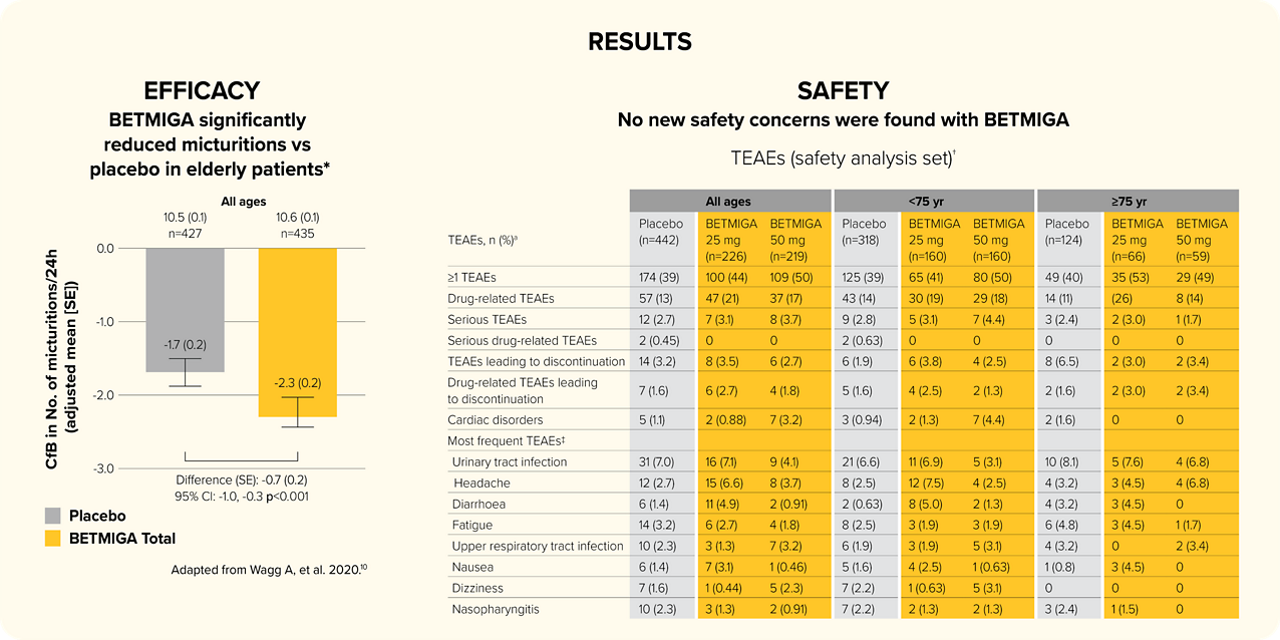
*Adjusted mean changes generated from ANCOVA models with treatment, sex (<75 years or ≥75 years) and country as fixed factors, and baseline value as a covariate.
†TEAE defined as an adverse event that started or worsened in the period from first double-blind medication intake until 30 days after the last double-blind medication intake. The number of patients reporting an event is presented.
‡Affecting 2% of any treatment group.
CfB, change from baseline; CI, confidence interval; SE, standard error; TEAE, treatment-emergent adverse event.
CONCLUSION
References
1. BETMIGA (mirabegron) prolonged-release tablets. Summary of Product Characteristics 2. Nitti VW et al. Int J Clin Pract. 2013;67(7):619-632. 3. Green AR, et al. Drugs Aging. 2019;36(3):289–297. 4. Hilmer SN, Gnjidic D. Aust Prescr. 2022;45(4):118–120 5. Rudolph JL, et al. Arch Intern Med. 2008;168:508–513 6. Mintzer J and Burns A. J R Soc Med. 2000;93:457–462. 7. Parkinson L, et al. Med J Aust. 2015;202:91–94 8. Benner JS, et al. BJU Int. 2010;105(9):1276–1282. 9. EAU Guidelines on Management of Non-Neurogenic Female Lower Urinary Tract Symptoms. Available online: https://uroweb.org/guidelines/non-neurogenic-female-luts. Accessed January 2026. 10. Wagg A, et al. Eur Urol. 2020;77(2):211–220.
Adverse events should be reported. For Ireland, Healthcare professionals are asked to report any suspected adverse reactions via: HPRA Pharmacovigilance, Website: www.hpra.ie or Astellas Pharma Co. Ltd. Tel:+353 1 467 1555, E-mail: irishdrugsafety@astellas.com.
MAT-IE-BET-2026-00008 Sep 2026


